Library
What Is Vietnamese Lacquer Painting (Sơn Mài)?
Sơn mài is Vietnamese lacquer painting. Learn how repeated layers, sanding and polishing reveal colors and materials below the surface.
By AE&Adamas Editorial · Published
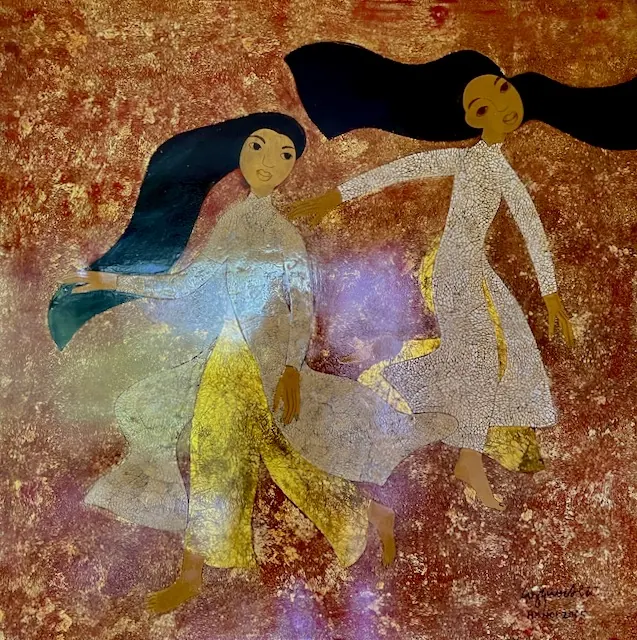
**Vietnamese lacquer painting, commonly called sơn mài, is an art form built with lacquer and, in some works, materials such as gold, silver, eggshell or shell inlay. Artists apply and work successive layers, then sand and polish the surface so colors and details emerge from within the object. The image is inseparable from the material process that produces it.**
That last point matters. A dark red and gold image can borrow the appearance of lacquer, but color alone does not make it a lacquer painting. Traditional lacquer work is identified by its materials and method as well as its visual character.
Why Vietnamese lacquer painting is distinctive
Natural lacquer, or sơn ta, had practical and aesthetic uses in Vietnam long before it became a modern painting medium. The National Gallery Singapore notes that natural lacquer has been used in Vietnam for centuries. It could protect objects with a hard surface while creating a luminous finish through layers of color.
In the twentieth century, artists began treating lacquer as a field for modern painting. National Gallery Singapore records that a lacquer studio opened at the École des Beaux-Arts de l’Indochine in Hanoi in 1927. The studio brought the lacquer artisan Đinh Văn Thành into contact with students and teachers. By the 1930s, lacquer was widely used on flat, two-dimensional supports as a painting medium.
This history gives sơn mài a double character. It grows from longstanding Vietnamese material knowledge, and it also belongs to the history of modern art. Artists did more than transfer oil-painting subjects onto a lacquered surface. They explored what lacquer could do that other media could not: hide and reveal, hold light below the surface, move between opacity and translucency, and turn sanding into part of image-making.
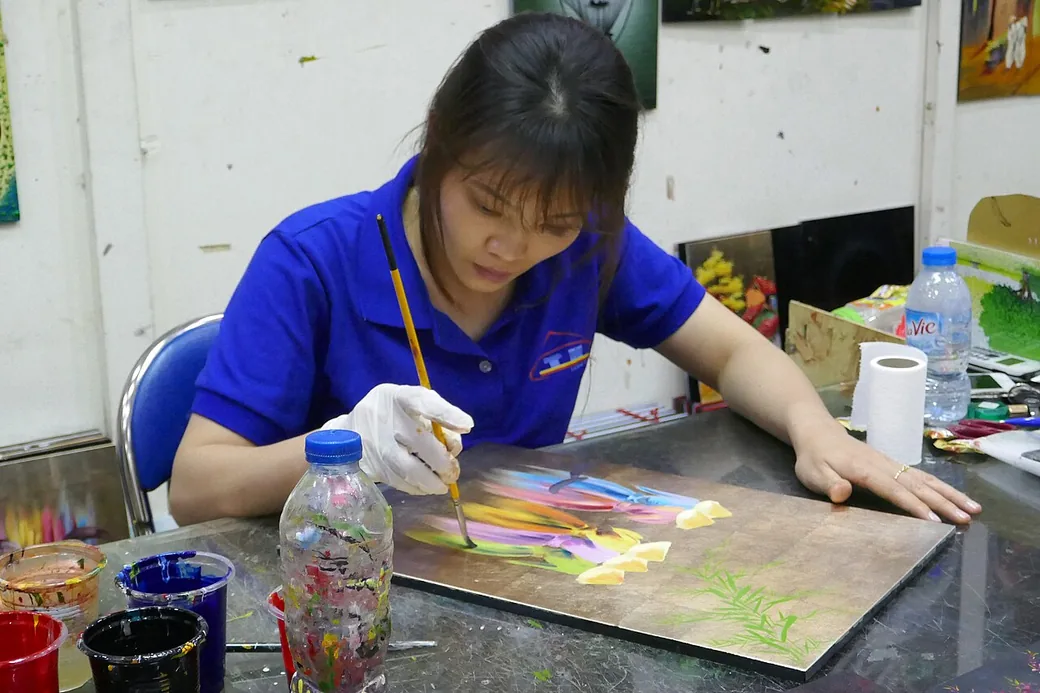
How is a Vietnamese lacquer painting made?
A lacquer painting develops through repeated physical stages rather than a single layer of visible paint. The exact recipe varies by artist, workshop, period and object, but the core logic is cumulative.
- Prepare a stable ground. The support must be made ready to receive lacquer layers.
- Build the image in stages. The artist applies lacquer and may introduce colored layers or inlaid materials.
- Let each stage set. New work depends on the condition of the layers below it.
- Sand the surface. Abrasion reveals selected colors and materials that were partly buried.
- Polish the work. Polishing controls sheen and brings depth, contrast and radiance into view.
National Gallery Singapore describes the process as iterative: layering, inlaying, sanding and polishing. This is why the surface of a lacquer painting can feel both flat and deep. A highlight may sit at the surface, glow through a translucent layer or appear as a fragment exposed by sanding.
Materials are part of the image
Lacquer paintings do not all use the same palette or inclusions. Depending on the work, an artist may use black, red, brown, gold or silver alongside eggshell or other inlaid elements. These materials are not decorative labels added after the fact. Their opacity, reflectivity, texture and response to sanding shape the composition.
Mother-of-pearl inlay is a related material tradition, but it should not be reduced to an iridescent pattern. The official Vietnam Tourism rural portal describes the process at Chuôn Ngọ as drawing a shape, sawing mother-of-pearl, carving the receiving surface, embedding the nacre pieces and polishing the result. A printed pearlescent effect may recall that play of light; it does not contain shell or reproduce the inlay process.
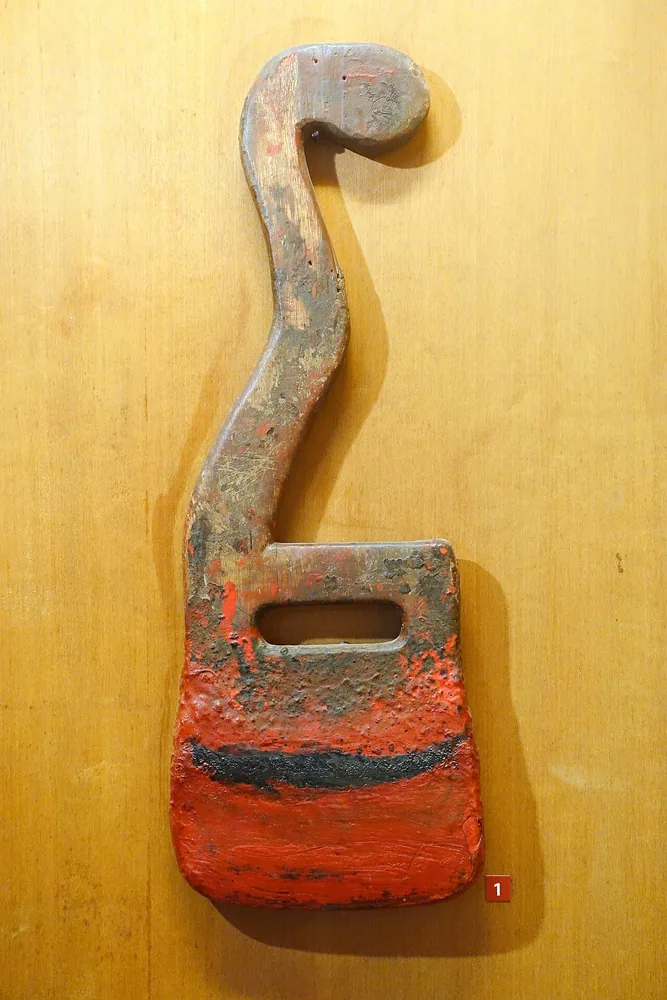
How to look at a lacquer painting
The most useful first question is not “What does it depict?” but “How does the surface make the image visible?”
Look for depth created without linear perspective
Lacquer can create spatial depth through changes in sheen, density and color. A black field may read as an empty night, a wall of material or a deep background depending on the light. Gold can behave like an object, an atmosphere or a flash at the edge of a form.
Watch the balance of opacity and translucency
Some passages absorb light while others return it. This makes the image change as the viewer moves. The surface may seem restrained from one angle and radiant from another.
Notice what sanding reveals
In an oil painting, a visible brushstroke often records the last action on the surface. In lacquer, a visible mark may be an earlier layer brought back into view. The finished image can therefore carry a compressed record of its own making.
Read inlay as structure
Eggshell, shell or metallic material can define a face, a line, an area of light or a break between forms. It is more useful to ask what the material does in the composition than to treat every bright fragment as ornament.
Vietnamese lacquer painting and lacquer-inspired art are different categories
- What creates the image? Lacquer: Applied lacquer and a material process. Print: Ink or pigment printed on paper or fabric.
- How is depth produced? Lacquer: Layers, inlay, sanding, polishing and material reflectivity. Print: Printed color, contrast, texture simulation and composition.
- Can it include gold, eggshell or shell? Lacquer: Some works do; materials must be documented for the individual work. Print: A visual may imitate these effects without containing the materials.
- What should the seller disclose? Lacquer: Medium, support, materials, maker and provenance. Print: Print substrate, print method, design process and the fact that effects are printed.
- Can appearance authenticate it? Lacquer: No. Documentation and physical examination matter. Print: No. Read the product description and materials field.
A useful description names the category plainly. “Vietnamese lacquer painting” describes a material art form. “Lacquer-inspired” describes a visual relationship. The second phrase should never be used to imply that a paper print, digital image or DTG garment is handmade lacquer.
How AE&Adamas uses the phrase “lacquer-inspired”
AE&Adamas currently applies a lacquer-inspired visual vocabulary to printed products. The artwork is AI-assisted under human creative direction and review, then prepared for made-to-order printing. The existing catalog does not contain hand-painted lacquer panels.
Three landscape designs translate real Vietnamese places into flat printed images:
- Tràng An · Ninh Bình, Etsy listing 4618612557 uses deep black, dark jade, aged-gold color and ivory patterning around water, cliffs, trees and boats.
- Hà Giang · Mã Pì Lèng, Etsy listing 4617923067 builds a dramatic view of the Nho Quế River and Tu Sản Canyon with dark jade, aged-gold and black.
- Golden Bridge · Đà Nẵng, Etsy listing 4616350880 places the bridge and its giant hands against a black, jade and aged-gold field.
These are physical 28 × 20 inch prints on 189 gsm matte paper, sold unframed according to the catalog snapshot checked on 17 November 2026. The lacquer depth, gold, crackle and eggshell-like details are printed effects. Buyers should use the exact Etsy listing for current options, price and delivery information.
The apparel follows the same disclosure standard. The Christmas Tree Hoodie, listing 4617803280 and Personalized Family Hoodie, listing 4619113002 use front DTG prints on black fabric. Their jade, vermilion, ivory and antique-gold colored details are printed. The garments contain no applied lacquer, gold leaf, shell inlay, metallic foil or embroidery.
Why the distinction protects the art and the buyer
Clear language gives traditional work the material specificity it deserves. It also tells a buyer what will arrive. Someone purchasing a lacquer panel may care about the support, materials, artist, workshop and conservation history. Someone purchasing an art print needs the paper size, paper type, whether a frame is included and how the image was produced.
The two experiences can share a visual conversation without becoming the same object. A contemporary print can study lacquer’s controlled darkness, warm metallic color and layered-looking light. Its value rests on the honesty and quality of that interpretation, not on being presented as a traditional object.
Questions readers often ask
Is sơn mài the same as any object coated with lacquer?
No. In an art context, Vietnamese lacquer painting refers to an image-making practice in which lacquer’s layers, surface and working process are central to the finished work. A protective lacquer coating on furniture or a decorative object has a different function, even when related materials and skills are involved.
Does every Vietnamese lacquer painting contain eggshell or gold?
No. Materials vary by work. Eggshell, gold, silver and inlay are possibilities, not requirements. Check the medium statement and documentation for the individual artwork.
Can I identify real lacquer from a photograph?
A photograph can show color, pattern and sheen, but it cannot establish the medium by itself. Ask for the material description, support, maker, technique and provenance. For a commercial product, read the materials and production method before relying on words such as “lacquer look” or “inspired.”
Are AE&Adamas prints traditional lacquer paintings?
No. They are flat images printed on matte paper. Their color and surface patterns are inspired by Vietnamese lacquer aesthetics. The product descriptions state the paper, print format, design process and material limits.
Continue exploring
Read Lacquer Painting vs. a Lacquer-Inspired Print for a practical comparison, or visit Materials & Care for the current AE&Adamas product materials.
Works in this article
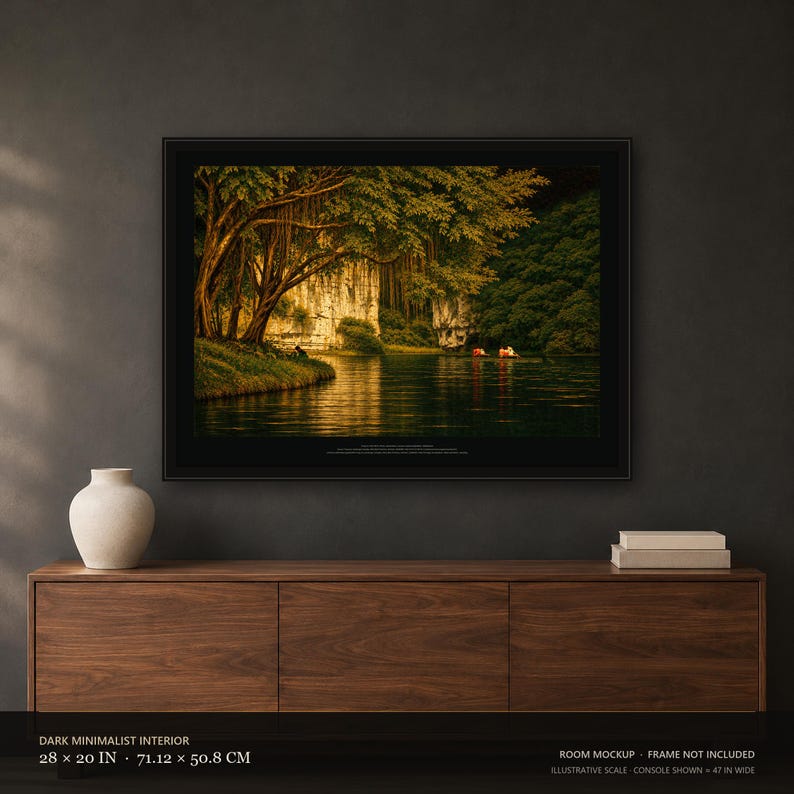
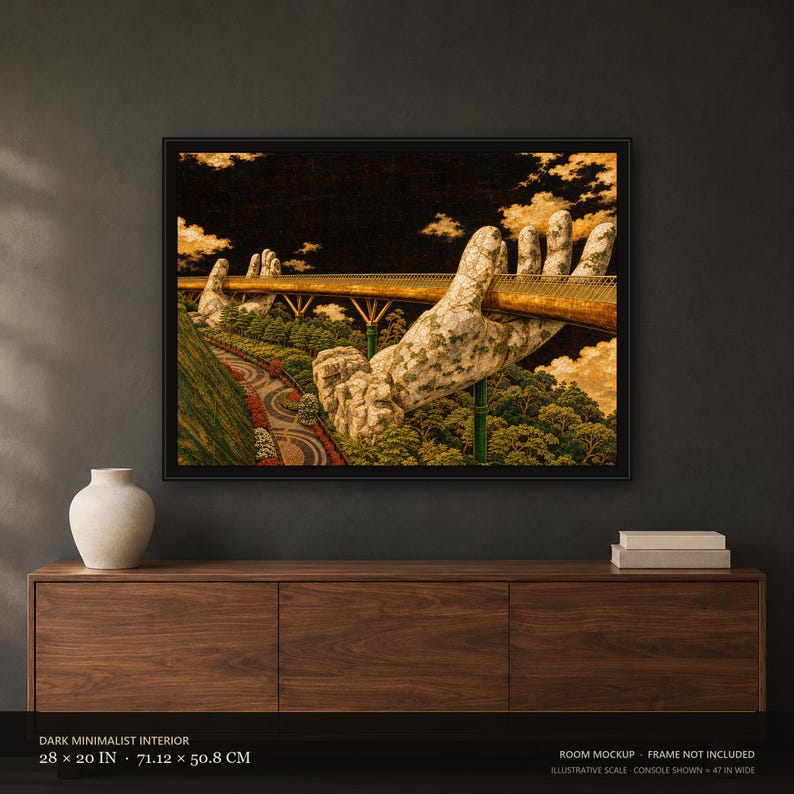



Product facts: Etsy listings checked . Etsy shows the current price, options and delivery estimate.
Sources
- Vietnamese Lacquer Painting: Between Materiality and History — National Gallery Singapore
- Chuon Ngo nacre inlays — Vietnam National Authority of Tourism
These sources give cultural and geographic context. They do not describe how AE&Adamas products are made; product facts come from the dated Etsy catalog check.